If your company does not offer a 401(k) match, it’s smart to compare your employer’s 401(k) plan with an IRA to determine which offers better investment
options and lower fees. While 401(k) plans still provide tax advantages, such as tax-deferred growth or tax-free withdrawals with a Roth 401(k), they can sometimes come with limited
investment choices or high administrative costs. IRAs, on the other hand, often offer a wider range of investments and lower fees, giving you more flexibility and control.
If your 401(k) is costly or restrictive, contributing to a Traditional or Roth IRA first may be a better option, especially if you meet the income eligibility requirements.
As of 2025, the IRS allows individuals to contribute up to $7,000 per year to a Traditional or Roth IRA, with an additional $1,000 catch-up
contribution for those aged 50 and older, bringing their total to $8,000. For workplace retirement plans like 401(k), 403(b), and most 457 plans, the annual contribution
limit is $23,500, with a $7,500 catch-up contribution for individuals aged 50 and older, allowing a total of $31,000. Additionally, under the SECURE 2.0 Act, individuals
aged 60 to 63 may be eligible for an enhanced catch-up contribution of $11,250, raising their total allowable 401(k) contribution to $34,750, if their plan permits.
As of 2025, employees can contribute up to $23,500 to their 401(k) plans, an increase from $22,500 in 2023. For those aged 50 and older, the catch-up contribution limit
remains $7,500, allowing a total contribution of up to $31,000. Additionally, under the SECURE 2.0 Act, individuals aged 60 to 63 are eligible for an enhanced catch-up contribution of $11,250,
bringing their total allowable contribution to $34,750, if their plan permits.
As of 2025, employees can contribute up to $23,500 to their traditional tax-deferred 401(k) plans. For those aged 50 and older, the IRS allows an additional catch-up contribution of $7,500,
bringing their total allowable contribution to $31,000. Furthermore, under the SECURE 2.0 Act, individuals aged 60 to 63 are eligible for an even higher catch-up limit of $11,250, allowing them to contribute
up to $34,750 in 2025, if their plan permits.
Putting 100% of your retirement savings into Certificates of Deposit (CDs) is not advisable, as it can severely limit long-term growth and increase the risk of falling behind inflation.
While CDs are safe, predictable, and FDIC-insured, they typically offer lower returns than other investment options like stocks or mutual funds, making them unsuitable as a sole retirement strategy.
Relying entirely on CDs can guarantee underperformance and reduce your purchasing power over time. Instead, CDs should be part of a diversified retirement portfolio that includes a mix of assets—such as stocks,
bonds, and tax-advantaged accounts—to balance risk and provide the potential for higher returns needed to sustain income throughout retirement.
You need to work at least 10 years in your life to become eligible for
retirement benefits.
The earliest age at which you can begin getting
Social Security retirement benefits is 62 for women and 65 for men. However, the full retirement age is 66 if you were born between 1943 and 1954;
66+ if you were born between 1955 and 1959; and 67 if you were born in 1960 or later. You will receive a reduced benefit if you elect benefits prior to your full retirement age.
As of 2025, the Social Security tax rate remains 12.4%, with 6.2% paid by the employee and 6.2% paid by the employer, unchanged from previous years.
The Social Security wage base—the maximum amount of earnings subject to this tax—has increased to $176,100, up from $168,600 in 20242. This means that only the first $176,100 of
a worker’s wages are subject to the Social Security portion of FICA taxes, resulting in a maximum tax of $10,918.20 per person.
As of 2025, the Social Security tax rate remains 12.4%, with 6.2% paid by employees and 6.2% by employers, unchanged from previous years. The Social
Security wage base—the maximum amount of earnings subject to this tax—has increased to $176,100, up from $168,600 in 2024. This means that only the first $176,100 of a worker’s wages
are subject to the Social Security portion of FICA taxes, resulting in a maximum tax of $10,918.20 per person.
As of 2025, the average monthly Social Security benefit for a retired worker is approximately $2,002.39, according to the Social Security Administration.
This reflects a steady increase from previous years, driven in part by cost-of-living adjustments (COLAs).
As of 2025, the average monthly Social Security benefit for retired workers is approximately $2,002.39, reflecting steady increases due to cost-of-living adjustments.
The total number of people receiving Social Security benefits has grown to about 74.1 million, including retirees, survivors, and those receiving disability benefits.
This marks a significant rise from the 56 million beneficiaries in 2012, and the number is projected to continue increasing toward an estimated 91 million by 2035.
A nonworking spouse can receive up to 50% of a retired worker’s full Social Security benefit—also known as the primary insurance amount (PIA)—provided
they claim the benefit at their full retirement age (FRA). If the nonworking spouse claims benefits before reaching FRA, the amount is permanently reduced, potentially to as
low as 32.5% of the worker’s benefit depending on how early they file. To qualify, the couple must have been married for at least one year, and the working spouse must already
be receiving their Social Security retirement benefits.
According to the 2025 annual report from the Social Security Board of Trustees, the U.S. government estimates that the Old-Age and Survivors Insurance (OASI)
Trust Fund—which pays retirement benefits—will be depleted by 2033. At that point, the program will be able to pay only about 77% of scheduled benefits using ongoing payroll tax revenue.
If no changes are made, the combined trust funds for retirement and disability benefits are projected to run out in 2034, at which time only about 81% of total scheduled benefits would be payable.
These projections highlight the urgent need for legislative action to ensure the long-term solvency of Social Security.
Telemarketing Fraud: Someone you do not know contacts you to ask for your personal and financial information.
Tax Return Fraud: Tax return fraud is becoming a bigger and bigger problem every year. Most people panic when they find out they are a victim, and for a good reason.
Phishing: E-mails that appear to be sent from a well-known source to attempt to get your sensitive information such as birthday, social security number, usernames/passwords of your bank account and/or credit card details.
Classified Ad and Auction Site Scams: Criminals post ads for goods that don't exist and steal consumers' credit card or bank account information.
Employment/Job Scams: Fake job offered in exchange for an up-front fee and/or personal information, such as social security number and birthday.
False Charities: Organizations tricked consumers into giving by claiming that donations would support police or firefighters
in the line of duty, people in a disaster area, or that the donations would assist military families serving in overseas, and by misleading consumers about how much of the money would go to those causes. Actually
they collect money but don't use it for these philanthropic purposes.
Fake Checks: Consumers given mysterious checks and are asked to call back to receive money after paying a fee and/or providing ban account or credit card information.
These phony checks that often came in connection with a foreign business or work-at-home offer, or notice that the caller had won a foreign lottery.
Gift Card Scams: Fake gift cards sold to people who buy cards through online auction or classified sites.
Work-at-Home Scams: Posting advertisements for work-at-home employment that were actually ploys to collect fees for “applications,” or “background checks,” or to steal consumers' identity information.
Nigerian Letter Fraud: Criminals send you a letter from Nigeria or overseas offered the recipient the "opportunity" to share in a percentage of millions of dollars after paying an advance fee.
"Money has given me the independence to do what I love daily. Beyond that it has no real utility for me but has enormous utility for others. That is why I'm giving it away." -
Warren Buffett
“The other approach, of course, if you can’t save money, is to be really nice to your kids.” -
Dan Ariely.
"If nobody knows nothing, you own everything." -
John Bogle
“Know what you are doing, avoid get-rich-quick schemes, do your homework, don’t bet the ranch.” -
Leon Black.
"There is nothing emotional about money; you need to have a sound basis for what you buy or own." -
Meredith Whitney
"My father warned me never to move into the neighborhood of poverty” -
Ben Stein: Staying Out Of Bad Money Neighborhoods
“Pay attention to the big themes, because that’s what will help you earn ten times your money.” -
Barry Sternlicht
"Sometimes to make money you have to spend it, whether that’s paying for college, buying a house, buying a good stock or investing in a business.” -
Kelly Phillips Erb.
"First, you have to be very concentrated, develop an expertise like many entrepreneurs do and secondly, you have to get your hands on somebody else's money." -
Bruce Greenwald.
“Money enables you to put bread on the table at first, but it also enables you to give back in a big way.” -
Leon Cooperman.
“The best thing you can do with your money in your 20s is to not make mistakes.” -
Alexa von Tobel.
“If you are going to be a passive, minority investor, don’t do it with borrowed money." -
Marty Whitman.
Checking Account: A checking account is a federally insured bank account that allows easy access to the money you keep in it, and earn interest on it. You can have your paycheck deposited directly into it, make payments online or write a physical check to pay bills, make purchases and withdraw cash.
Savings Account: A savings account is a bank account that allows you deposit, withdraw, and earn interest on your money. It's a federally insured account used for keeping money for a later date, and separate from everyday spending cash withdrawn from a checking account.
Annual Percentage Rate (APR): The APR is the annual rate of interest charged to borrowers and paid to investors.
Annual Percentage Yield (APY): The APY is the effective annual rate of return earned on a savings deposit or investment taking into account the effect of compounding interest.
Certificate of Deposit (CD): A CD is a product offered by consumer financial institutions (e.g.; banks, credit unions) that provides an interest rate premium in exchange for the customer agreeing to
leave a lump-sum deposit untouched with a fixed interest rate and fixed date of withdrawal for a predetermined period of time. The maturity date is when money from the CD can be withdrawn, otherwise a penalty is charged if the money is taken out earlier.
CD Ladder: A CD ladder is a strategy in which the lump-sum deposit is divided into equal amounts and invested them in CDs with different maturity dates (e.g.; $10,000 in a one-year CD; $10,000 in a two-year CD; $10,000 in a three-year CD, $10,000 in a four-year CD, and $10,000 in a five-year CD).
CD Calculator: This Certificate of Deposit (CD) calculator can assist in determining accumulated interest earnings on CDs over time.
401(k) Plan: A 401(k) is a retirement savings plan that allows eligible employees of a company to save and invest some money from their paycheck before taxes are taken out; taxes are not paid until the money is withdrawn from the 401(k) account.
Individual Retirement Account (IRA): An IRA is a place where you can keep money for long-term savings, like retirement. There are two types of IRAs; Traditional IRA are set up to provide you with a tax break for the year you put funds into it;
Roth IRAs are designed to give you tax-free money later, you won’t receive a tax break on the amount of money you put into the account. At age 59 and 1/2, when you take out the money you may have to pay taxes on them from the Traditional IRA account, and you won’t be charged taxes on the Roth IRA account.
IRA CD: An IRA CD is simply an IRA where all the money is invested in CDs holding in a Traditional IRA or Roth IRA, offering tax advantages.
Jumbo CD: Jumbo CD is a CD that traditionally require a minimum balance of $100,000. In exchange for the higher minimum, these CDs may have a slightly higher interest rates than a regular CD.
Money Market Account: These are similar to having a savings and checking account rolled into one account. Most money market accounts pay a higher interest rate than regular checking and savings accounts, and often allow you to pay bills and withdraw money, but the account holder could be limited
to a certain number of transactions each month. Money market accounts also have a minimum balance and monthly fees, but are backed by the FDIC. It's not money market funds, which are often used in brokerage accounts and are not backed by the FDIC.
Renewal Grace Period: This is the time a consumer financial institution (e.g.; banks, credit unions) gives you before rolling over your current CD into one of the same maturity.
529 Plan: A 529 plan, legally known as “qualified tuition plans,” is a tax-advantaged savings plan designed to encourage saving for future education costs. 529 plans are sponsored by states, state agencies, or educational institutions and are authorized by Section 529 of the Internal Revenue Code.
Active Banks: There are 4,236 active FDIC-insured commercial banking institutions with 72,166 commercial bank branches in the U.S. as of 3/2023; most banks have at least one physical branch, and some have dozens or hundreds.
FDIC vs NCUA: Federal Deposit Insurance Corporation (FDIC) only insures deposits in banks; credit unions have their own insurance fund, run by the National Credit Union Administration (NCUA).
How to Choose a Bank
Fees and Rates: A consumer financial institution (e.g.; bank, credit union) might charge fees for monthly bank account maintenance, ATM use, overdrafts, transferring money between accounts and sending you paper statements, you should look for a bank or credit union that offers no fee or lower fees.
Credit Card or Loan: If you’re looking for a consumer financial institution for a credit card or loan, you should compare interest rates for credit cards and loans and the rates you would earn on deposit accounts.
Advanced Technology: If you don’t want to step into a consumer financial institution, you should look for a bank or a credit union that helps you stay on track with your money, offers securely remote check deposits, makes online payment and transfers money securely and easily.
Money Safety: If you do not want to lose your money when a bank or a credit union files for bankruptcy, you should look for consumer financial institutions whose deposits are backed by the Federal Deposit Insurance Corp or the National Credit Union Administration, which insure balances of up to $250,000.
Electronic Funds Transfer Act: If you didn’t lose your debit card and money disappears from that account, you are not liable for any charges if you report the theft within 60 days.
If you wait more than 60 days you won’t get all the money back.
$25 deposit to open; $12 monthly fee unless direct deposit of at least $500, minimum balance of $1,500 or $5,000 average daily balance in linked accounts.
$50 to open; $6.95 monthly fee with online statements or $8.95 with paper statements unless direct deposits of at least $500 or average account balance of $1,500.
$50 to open; $10 monthly fee unless direct deposit of at least $100; $1,500 average balance or a mortgage with BB&T.
No fee.
Safeguarding Your Credit Score
Pay all bills on time to avoid late-payment fees; do not miss or make late loan payments.
Pay down or pay off credit card balances as soon as their bills arrive.
Do not use over 30% of your available credit line.
Keep your oldest accounts open.
Use only one or two cards.
Have a variety of loans, such as a mortgage or car loan.
Under federal law, you’re entitled to a free credit report. Check your credit reports on a regular basis, at least once a year, to make sure there are no errors on it at
Get free credit reports from each nationwide credit reporting agency:
Equifax (1-800-685-1111),
Experian (1-888-397-3742), and
TransUnion Corporation (1-800-916-8800); review each carefully, and request any fraudulent transactions be deleted.
If a credit card company raises your interest rate, it will have to tell you the reasons. Furthermore, credit card issuers must give you 45 days advance warning of upcoming changes (e.g.; interest rates).
If your credit rate increases, credit card issuers must reevaluate it every six-month period. If you deserve to have it lowered, the card issuer must comply within 45 days of the evaluation.
Customers have the right to opt out of fee increases and interest rate hikes (e.g.; cancel cards and pay off the existing balances).
Consumers get 21 days to make a payment after a bill is delivered instead of 14 days.
Credit card issuers can not raise rates on any existing balances. If your rate increases, it will only apply to new charges.
Issuers cannot raise your rates because you miss a payment or fall behind on a different account.
Payments will be applied to the balance with the highest interest rate first.
Penalty rates on existing balances can only be applied if your payment is 60 days late. If you then remain in good standing, your rate must go back down after six months.
Promotional rates must last at least six months.
Any penalty fees or rates must be "reasonable and proportional," as defined by the Federal Reserve.
Card issuers must periodically review your account and potentially reduce your rates.
Credit card issuers cannot charge you a penalty fee that is larger the infraction. For example, if you are late on a $10 payment or you spend more $10 more than your max, your penalty fee cannot be more than $10.
Credit card issuers will no longer be able to charge you an inactivity fee or not using your card.
All gift cards sold must be good for at least five years. You can also request a replacement for any expired gift card for free. Only one fee per month can be charged and dormancy fees can only be assessed if you haven't used your gift card in a year.
Credit Card 101 for Students
To open a credit card account if you are under 21, you will need to show that you have the income to make required payments or get a co-signer 21 or older who has the ability to do so.
Anyone 21 or older - not just parents, legal guardian or a spouse - can co-sign for younger students to get a credit card.
Once you have a credit card with a co-signer, if you want a higher credit limit, the co-signer must agree in writing to the increase.
Co-signer is equally responsible for the debt, and his/her credit card scores can be impacted.
If you need to use a credit card to buy a product online, you only use it with a "https" site; never use a credit card on a site without "s" after http.
Financial Scams Prevention & Detection
Be vigilant. Scammers are impersonating your Bank. When in Doubt - Don't Reply!
Scammers are making fraudulent calls informing customers of fraudulent transactions initiated on their account. Calls are followed by text messages containing malicious links to fake login pages.
Customers who engage and enter their credentials on the fake site are having their Business Online Banking accounts compromised!
Red Flags:
Unexpected Call and Text with a link. Be suspicious if you receive a call claiming fraud, typically followed by a text message asking you to "resolve" the issue.
Fake Website URLs. Be wary of unusual domains and not your bank's URL.
Requests for Credentials Over the Phone. Your bank will NEVER ask for your full password or one-time passcode over the phone.
If you encounter suspicious activity related to your account with Bank, you can contact your bank by calling the number provided in your bank statement.
If someone contacts you by phone, text, email, computer alert or social media to ask you to act immediately, provide your personal information or codes,
and/or pay in an unusual way, these are signs you're being scammed.
Never Wire Money to ...
Someone you don't know.
Someone claiming to be a relative in a crisis - and who wants to keep their request for money a secret.
Someone who says a money transfer is the only form of payment that's acceptable.
Someone who asks you to deposit a check and send some of the money back.
Be Alert:
A scammer may call, email, or text you, pretending to be from your bank, and ask for information that allows them to access your bank account.
If you receive a one-time passcode you didn’t request, discard it.
If you receive a text message or an email appeared to be from your bank requesting to click on a link, discard it.
Scammers may tell you there is an urgent fraud situation to catch you off guard.
Hang up on suspicious calls immediately, even if they appear to be from your bank. Scammers sometimes use technology to "spoof" phone numbers, so it appears the call is originating from your bank.
If you have any concerns that the call might not be legitimate, call your bank at the number found on your account statement.
Scammers may make unusual requests for sending or transferring money.
Fraudsters may contact you to pretend to help you with an ongoing fraud situation. To reverse it, they suggest you transfer money "to yourself" when, in fact, the account you transfer money to belongs to the scammer.
This could cause you to lose money or even become unknowingly involved in a crime.
If you have any concerns that the call might not be legitimate, call your bank at the number found on your bank account statement.
Be Proactive:
Monitor your account activity regularly.
Set up bank account alerts so that you are notified for high dollar transactions or withdrawals on your bank accounts
Stay calm. Scammers may try to alarm you, so you will give them what they want. If you're told to take action right away, it could be a scam.
Identity Protection
Online:
Create complex passwords using a combination of letters, numbers, cases, and symbols to form an unpredictable string of characters that doesn't resemble words or names.
Change the password quarterly.
Use security feature on your mobile device, such as installing the free AT&T ActiveArmor mobile security app.
Avoid using public wifi network to eliminate risk of accidentally sharing secret, important, or sensitive information.
Update sharing and firewall setting.
Doing Business:
Do not carry your Social Security card in your purse or wallet; once it's loose, identify thieves can exploit it to get loans, obtain credit cards or other financial chicanery in your name.
Only give out your Social Security number when necessary.
Keep your personally identifiable information (PII) private. PII is information that can be used to distinguish or trace an individual’s identity, such as name, home address, phone number, social security number, driver’s license number, passport number, credit account number, or bank account number.
Do not share personal information via email or over the phone. Financial institutions never ask for your account number, Social Security number, address, PIN, or password in an email, text message, or incoming phone call.
If you have any concerns that the call might not be legitimate, call your bank at the number found on your account statement or credit card.
At Home:
Securely keep your financial records, academic records (e.g.; transcripts), insurance cards, account number, birth certificate, Social Security number, address, PIN, or password.
Check your bills and account statements carefully for unusual activity
Review your credit report and credit score at least once a year.
Check your mail; make an investigation if you stop getting a bill or start getting mails you do not recognize.
Identity Theft Protection:
Report the identity theft to the Federal Trade Commission. File a report online at IdentityTheft.gov or call their hotline at 1-877-438-4338.
Lock down your credit files. You have a right to a free credit freeze.
To learn how to place a freeze on the FTC’s website by searching for “Credit Freeze.” Once a freeze is placed, the credit bureaus can’t release any information without your permission.
Contact the Social Security Administration. Let the agency know that someone has stolen your Social Security number and is fraudulently using it for their employment. If you know your Social Security number has been compromised, you can
ask the Social Security Administration to block electronic access by calling 1-800-772-1213. You will have to verify your identity if you want to remove the block.
Get a “Self Lock” with E-Verify — a free online service that the federal government
provides to employers to check if an employee is eligible to work in the U.S. and also protects against identity fraud. Individuals can also create an E-Verify account.
If you use this option, you should unlock your Social Security number to allow an employer to check your status.
Get an identity protection PIN (IP PIN) to prevent someone else from filing a tax return using your Social Security number (SSN)
or individual taxpayer identification number (ITIN). The IP PIN is known only to you and the IRS.
Public Debt is the total of all government borrowings less repayments that are denominated in a country's home currency.
* CIA's World Factbook list only percentage of GDP, the debt amount and per capita is calculated with GDP (PPP) and population figures of same report.
Loan Calculator
Credit-Rating Firms
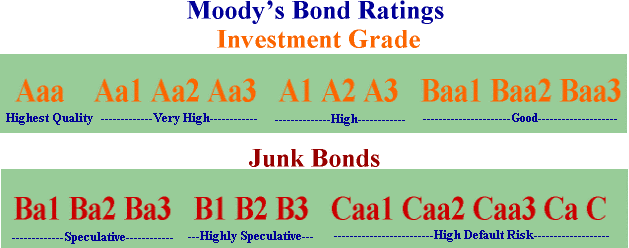
Moody's
- Found in 1900 and began rating
securities in 1909, Moody's Corporation rates more than 150,000 corporate, government securities, 75,000 public
finance obligations, 10,000 corporate relationships, and 100 nations. Moody’s has more
than 2,100 employees in 18 countries. Its revenue is $1.25 billion, including about $363.9
million in net income. The firm makes up about 40% of the credit-rating business.
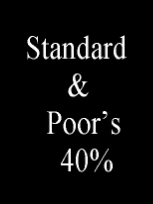
Standard & Poor's
- Found in 1860 and began rating corporate debt in 1916,
Standard & Poor's rates about 100 countries with more than $7 trillion in bonds and other
financial obligations in more than 50 countries. Standard & Poor's has more than 5,000 employees in
20 countries. Its revenue is about $1 billion. The firm makes up about 40% of the
credit-rating business.
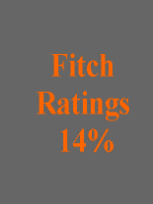
Fitch Ratings
- Found in 1913 and began rating business in 1924, Fitch Ratings
(Paris-based Fimalac SA), rates about 3,000 financial institutions, 1000 corporations, 85
countries and 39,000 municipal offerings. Fitch Ratings has about 1,400 employees in 50
countries. Its revenue is about $500 million, $125 million in net income. The firm makes up
about 14% of the credit-rating business.
eMacromall.com - Credit Card Payment Calculator
VISA
- Visa is a private, membership association jointly
owned by 21,000 member financial institutions around the world. With more than
1 billion cards
in circulation, and with unsurpassed acceptance in over 150 countries, the reach
and popularity of Visa-branded cards is nearly universal.
Master Card -
MC is one of the most recognized and
respected global payment brands in the world. With approximately
25,000 MasterCard, Cirrus and Maestro members worldwide, MasterCard
serves consumers and businesses, both large and small, in 210
countries and territories with over 22 million locations around the
globe.
American Express -
Established in 1850 in New York, American Express
Company is a diversified worldwide travel and financial services company. It is a leader
in charge and credit cards, Travelers Cheques, travel, investment products, insurance and
international and online banking.
Discover Financial Services -
A business unit of Morgan Stanley, operates the Discover® Card brands.
It offers a variety of Cards, including Discover Classic Card, Discover Gold Card, Discover
Platinum Card, Miles Card from Discover Card and an array of affinity cards.
The Federal Reserve System -
is the central bank of the United States, responsible for
providing the US with a safer, more flexible, and more stable monetary and financial system,
supervising financial institutions, and ensuring that consumers receive
adequate information and fair treatment in their business with the banking system.
Federal Deposit Insurance Corporation -
FDDI, a US independent agency, preserves and promotes public confidence in the US financial system by insuring deposits in banks for up to $100,000
(temporary $250,000 during the current world financial crisis), and by monitoring and addressing risks to the deposit insurance funds.
The World Bank -
is the financial organization that provides low-interest loans, interest-free credit, and grants to developing countries. Some 10,000 development professionals from nearly every country in the world work in the
World Bank's Washington DC headquarters or in its 109 country offices.
The International Monetary Fund -
The IMF is an international organization of 184 member countries with the headquarters in Washington, DC. Its operations -- which involve surveillance, financial assistance,
and technical assistance -- have developed to meet the changing needs of its member countries in an evolving world economy.
The African
Development Bank -
The AFDB is a regional multilateral development finance institution
established in 1964 and engaged in mobilizing resources towards the economic and social progress
of its regional member countries. It is headquartered in Abidjan (Côte d’Ivoire).
The Asian Development
Bank -
The ADB is a multilateral development
finance institution dedicated to reducing poverty in Asia and the Pacific. Established in 1966,
it is now owned by 64 members, mostly from the region. The ADB's headquarters is in Manila
with 26 other offices around the world.
The European Bank for Reconstruction and Development (EBRD)-
Established in 1991, owned by 60 countries and
2 intergovernmental
institutions, the EBRD uses tools of investment to help build market economies and democracies
in 27 countries from central Europe to central Asia.
The Inter-American Development Bank (IDB)-
Established in 1959 as a partnership between 19 Latin American
countries and the United States, the IDB is the main source of multilateral financing for economic,
social and institutional development projects as well as trade and regional integration programs
in Latin America and the Caribbean.